Basta! Give Us Pasta!
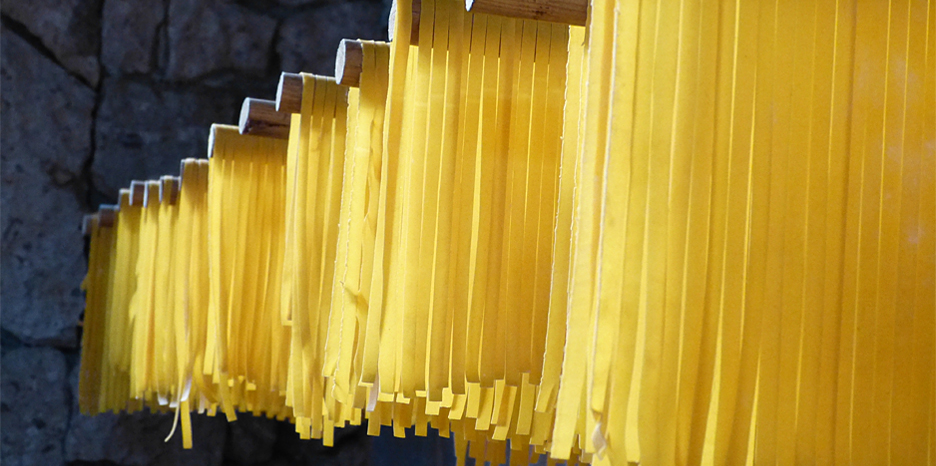
The word “pasta” comes from the Italian pasta which designates all products from hard wheat (Triticum turgidum durum) and water – spaghetti, macaroni, etc., but also, the dish itself. It is interesting fact that in such countries like Greece, Italy and France the production of pasta from flour made from wheat which is different from the hard variety, is considered a violation and should be explicitly stated on the packaging. In spite of this, some Bulgarian and Eastern European producers prepare pasta from ordinary wheat – the same one used to prepare white bread from. In Asia, having no scruples regarding it, they also prepare pasta from ordinary wheat. Contradictory to everything that we’ve said above, gnocchi are also considered a variety of pasta, even though they are most often prepared from potatoes, with egg and salt as part of the recipe.
Slowly and gradually, pasta production
started turning into an industry long, long time ago. Documents dating from 1244 and 1316 give account of pasta production in the region of Liguria. Information from 1574 speaks about establishing a Pasta Producers’ Guild in Genoa, while 3 years later a law was established, regulating the producers’ activities in Savona.
If there’s a place where pasta production is of national importance
it’s the city of Naples. The air there is dry enough for good drying of the pasta, yet humid enough for the dough not to become dry too fast. There are also enough fertile fields around to grow hard wheat. Production was kick-started as early as 17th century when it became clear that people in the region are more than their favorite food, which was still produced in the traditional, highly labor-intensive method – kneading the pasta dough with bare feet. The King Of Naples, Ferdinand II, decided to change the situation for the benefit of his subjects and commissioned the engineer Cezare Spadaccini to modernize pasta production. Thus, Spadaccini invented the first mechanized kneading press and this small technological revolution made pasta production both faster and cheaper.
There was enough food for the poor, merchants started successfully exporting pasta and soon Neapolitans became so famous with their pasta that people started calling them Macaroni.
The first pasta factory
however, hadn’t open in Naples but in Venice, in 1740. The Paolo Adami enterprise wasn’t sophisticated – a mechanical press and some boys to operate it. In 1763 the Duke of Parma granted a 10-year monopoly for production to Stefano Lucciardi who started making pasta genovese. Pasta continued its victorious march around Italy and in 1785 in Naples there were 280 shops selling the product.
Industrially-produced pasta is made
by pressing the dough through а disk with holes in it or by flattening it to a very thin crust and cutting various shapes out of it. Fresh pasta can be easily prepared at home and was in fact invented much earlier than the dry one. It has a delicate taste and can be prepared fast but is very easily over-cooked. It has a shorter expiry date than the dry one which can be kept for about an year, thanks to the low water contents, about 7%.